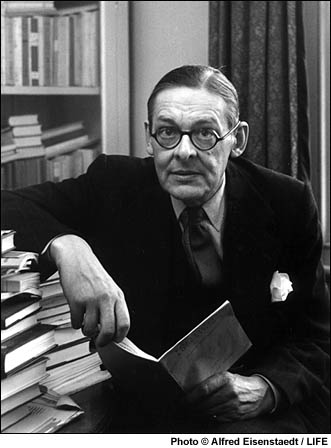
Mostrar mensagens com a etiqueta Eliot. Mostrar todas as mensagens

11/10/2017

TS Eliot's - "The Waste Land" Presentation

For Friday's class, we will be presenting "The Burial of the Dead", T.S. Eliot's first section of The Waste Land. Taking in account the poem's extension -and as advised by the teacher- we will mostly consider the first two stanzas.

However, analyzing such a complex poem, even the first two stanzas do require a longer discussion; therefore, if you want to prepare for our presentation, we suggest you to focus (mostly) on these three themes that tend to occur often in The Waste Land:
  • Life-Death(-Rebirth?);
  • Sense of decay;
  • Critical view of the modern culture.
P.S. If, for some reason, you forgot to watch or write down the title of the video mentioned in class, here you have it.  

- Ivo Rolo
  Caio Ishikawa
  Rafael Galrão

10/10/2017

T.S.Eliot - The poetic process

Reading T.S. Eliot might be difficult, especially when he expresses himself throughout metaphors. Regarding this aspect I have investigated the metaphor he uses in the text "Tradition and the individual Talent", that is to say:

"The action which takes place when a bit of finely filiated platinum is introduced into a chamber containing oxygen and sulphur dioxide". 

 Here's a platinum nugget (Russian Federation)

What I have found is a presentation about this chemical process as a creative process and also a comment made by a retired writer living in Vancouver (Barry Shell).

The following link belongs to the website www.slideshare.net and it is a presentation about the analogy between the creative process and the chemical reaction of the aforementioned elements in the text:

Wish you a good reading!

Fabrizio Consiglio


Ana Hatherly_Exhibition

After reading Eliot's "Tradition and the Individual Talent", I thought it would be relevant to share this FCGulbenkian's exhibition about the Portuguese artist and author Ana Hatherly (1929-2015) and the correlation between her works and the baroque era.
Indeed, the main idea of the exhibition explores exactly T.S. Eliot concept of tradition and the importance of the past. Here is the link for the museum description. Tickets cost 3€ (and possibly we have student discount!)

 Ana Hatherly, The Suspended Angels (1998)

Also, the curator organizes a series of activities surrounding the theme (including some guided tours and some workshops). There is particularly one that I think it is relevant, the open class "What sort of relationship can an artist have with a period that has passed or is now 'historical'?" (Which is part of the Master’s Aesthetics course programme at the Department of Philosophy, FCSH, UNL). Saturday, 25 November, 14:30 – Founder’s Collection. In Portuguese only

-Francisca Portugal

20/10/2016

M.V. Gato_"Agosto"

 Margarida Vale de Gato (1973-)

"Agosto"

Agosto sim, rigoroso Thomas,
é o mais fácil mês para ficar louca;
perdem os corpos pela roupa pouca
com frequência a pele e arde atrás

crudelíssimo o sol, isto se estás
há muito insone e sentes seca a boca
enquanto aos outros nus assiste a troca
escura e táctil que a febre satisfaz

e justifica. De resto, as sombras
foram todas tomadas por casais
como deve de ser. E já a mim

sequer a lua ou um leque cobrem.
Não chega amor na noite de chacais
e melgas. Escrever ainda assim.

M. V. Gato lê o poema aqui

Neste poema M. V. Gato interpela diretamente T. S. Eliot, reescrevendo o primeiro verso de "The Waste Land". Que outros tópicos unem os dois textos?

Picasso_Guernica

 
Pablo Picasso (1881-1973), Guernica
1937 (May 1st-June 4th, Paris). Oil on canvas (349,3 x 776,6 cm).

Source and more info here

In what ways does this mural relate to Eliot's "The Waste Land"?

"The Waste Land"_ver e ouvir

Na última aula, vimos a incrível interpretação que Fiona Shaw faz deste poema, inspirando novas possibilidades de leitura. Aconselho-vos a escutar e ver de novo este vídeo. 

Em contraponto, deixo ainda a versão do T. S. Eliot.


08/10/2012

"The Waste Land", T.S. Eliot


“The Waste Land”(1922), Thomas Stearns Eliot’s (1888-1965) masterpiece and most celebrated poem, edited by his close friend Ezra Pound (1885-1972), was written at a time in which the author endured a serious intellectual and spiritual crises as well as a personal dilemma concerning his marriage. In his unique way, T.S.Eliot expressed this complicated state of mind and feeling and he did it so brilliantly that even today one can mention a pre-Waste Land and a post-Waste Land period when referring to Eliot’s work.
The poem also marks a specific period in History – it portrays the decadent, degrading and chaotic plunge Britain and Europe (mainly Eastern) took in the Post-World War I aftermath.
It is not easy to read “The Waste Land” as its main language, characteristic of Eliot, involves the recurrent use of quotations and allusions to other works, references to many languages and the implication of a wide range of fact and learning. It resembles a puzzle that can only be deciphered through patience and, as the author put it, by someone who possesses a vast literary knowledge. The poem is also filled with private jokes and playful obscurity, which is the reason why, when it was first published, it was received by many critics as an hoax.
Divided into five parts, the whole poem can be viewed as an epic, albeit a condensed one, which main poles, around which all other themes revolve, are Death and Sex – Death, not as an ending, but viewed in the cyclic perspective of ‘in order for something to be created, something else must die’, the renewal of life, of nature, of history, of existence; and Sex, not so much the literal assumption of the word (the physiological need), but understood as the means to reach the state which is closest to the metaphysical experience of achieving Nirvana or, to put it in the Christian perspective as  Eliot did, “to be one with God”.
Starting with its title, throughout the reading of the poem, many questions are raised in one’s mind. What at first seems a simple reference can come to be so much more when one pores over its meaning. And this is the impression we get: that the author was aiming at raising as many questions as possible, leading us into digging a little of this “land” to find what lies underneath.
Due to its complicated nature and innumerous allusions and references, an exhaustive analysis of the whole poem would take us months (if not years) to fulfill, thus we have decided on focusing on the fifth part, entitled “What The Thunder Said”.  In it, Eliot explores three main themes: the journey to Emmaus (‘The Holy Bible”, Lc 24), the approach to the Perilous Chapel (reference to “The Grail Stories”, by Jessie L. Weston) and the decay of Eastern Europe (after World War I). In class we will approach and discuss this themes.
For now we’d like to challenge you to reflect and discuss upon the title and its relation to the poem, as well as a few questions for debate in class:
Question 1: How to understand the word “waste” in the whole context of the poem? Could it be the description of a worthless/ valueless land, where the ‘waste’ are its peoples and their thoughts? ‘Waste’ as in land of those who do not know; who are useless, dispensable? 
Question 2: On “What the Thunder Said” what represents the ‘Thunder’ to which all other deities (like Ganga and Himavant) and all Creation submit to? And why when it (singular) speaks, it refers to itself as ‘we’ (plural)?
Question 3: Can we find traces of transcendentalism in this part of the poem?
Question 4: The ending of the poem is also the end of a journey through the seas. Can you debate this in light of the modernist thought of “Life as a journey”? Is there a link it to the cyclic perspective of the whole poem?
Question 5: Can you ponder on what kind of reactions is the author aiming to provoke on his readers? 
This is most certainly one of the hardest poem that we’ve ever had to tackle with, but we can assure you: once the “lights go on”, its a pleasure to read it!